
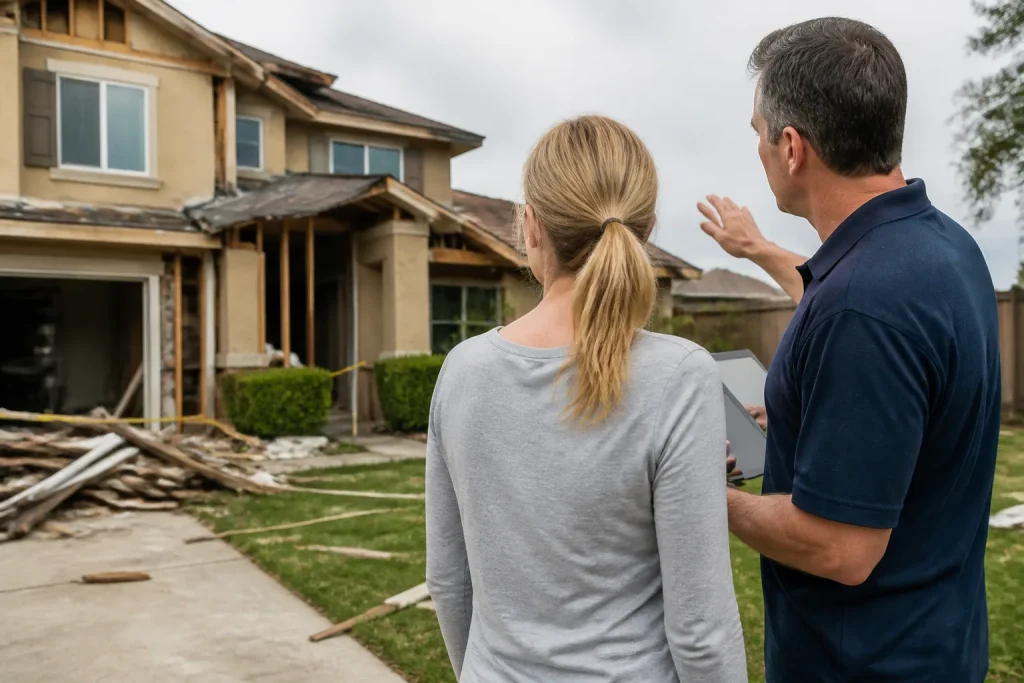
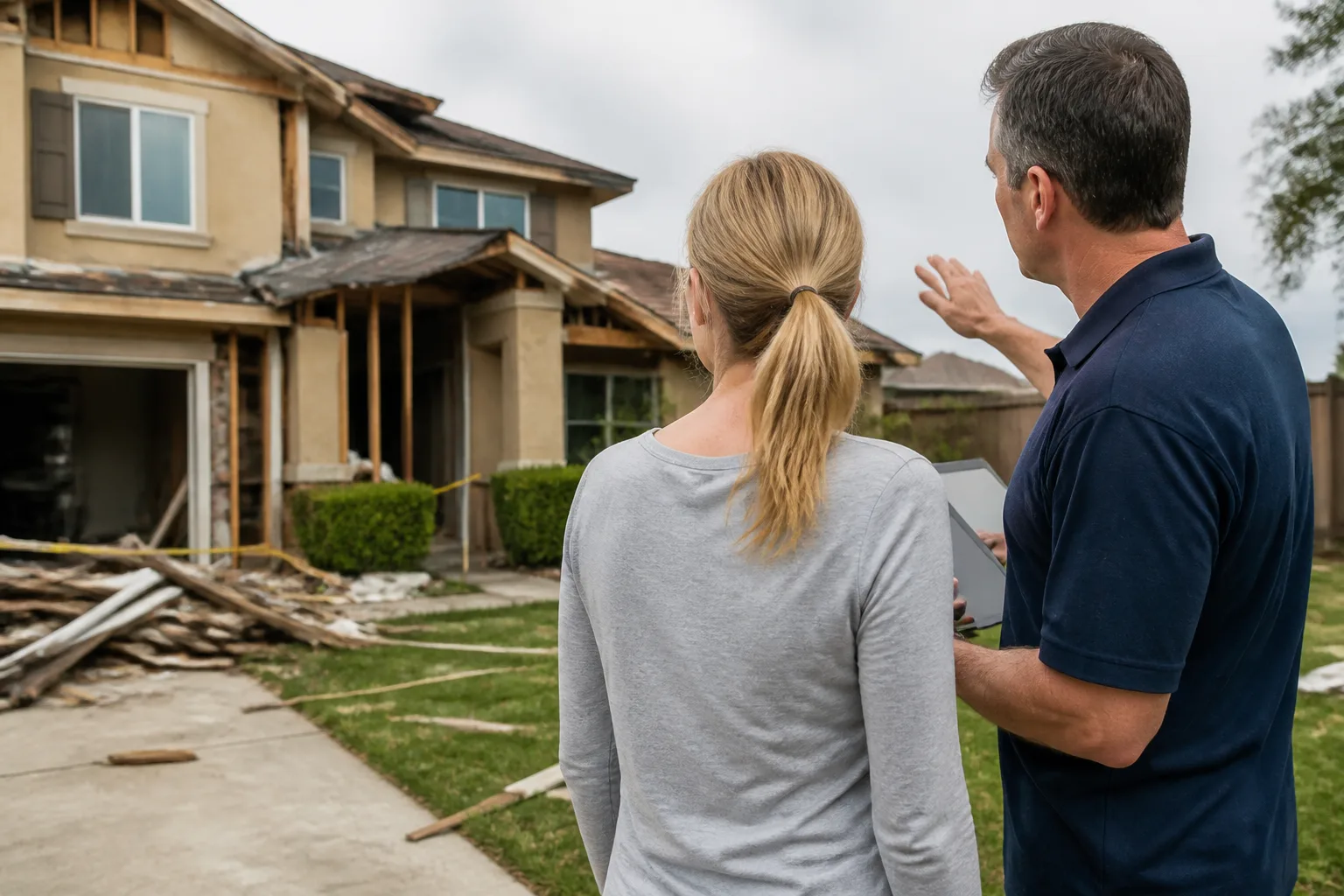
Emergency General Contractor Near Me: What Fullerton Homeowners Should Do First
If you have water pouring through a ceiling or roofing material scattered across your Fullerton yard, the first call is not your insurance company. The first 90 minutes determine whether your damage stays contained or compounds into a five-figure problem. The correct sequence is document, mitigate, notify. If you’d rather not handle the documentation and tarping yourself, call (866) 253-8554 and we’ll walk you through it.
We pulled a sopping wet ceiling from a house over in the Raymond Hills neighborhood last year where the homeowner had called his insurer first, waited on hold for 40 minutes, then called us. That delay meant the water from a failed supply line had time to soak through the subfloor and into the kitchen below. What started as a $6,000 drywall and insulation repair became a $23,000 two-room rebuild. The order of operations matters more than most people think, and in California, it can directly affect what your policy pays.
What “Mitigate” Actually Means Under a California Homeowner’s Policy
Your policy in Fullerton almost certainly includes a duty to mitigate ongoing damage. In plain language: once you discover a problem, you are legally expected to take reasonable steps to stop it from getting worse. That means shutting off the water at the main when a pipe fails, killing power to a wet circuit from the breaker panel, and covering breached areas with tarps or board-up materials.
We see a lot of confusion about what “reasonable” looks like. You don’t need to perform a full repair before your insurer inspects. You do need to prevent active water intrusion, exposed wiring, or an open roof deck from causing additional loss. A tarp over a damaged roof section and a wet-dry vacuum on standing water checks the box. Waiting until Monday because it’s a weekend does not.
Here is the sequence we recommend for any Fullerton homeowner facing a construction emergency:
- Shut off the source: water main, gas line, or circuit breaker, depending on what failed.
- Photograph everything before moving anything. Wide shots of the room, medium shots of the affected area, close-ups of the damage.
- Move valuables and furniture out of the wet zone if it is safe to do so.
- Call an emergency-capable general contractor like Elmwood Contractors home to stabilize the property.
- Call your insurer with documentation already in hand and mitigation already underway.
We carry standing relationships with roofing supply houses that stock GAF and Owens Corning underlayments and fasteners, which means when a Fullerton home loses shingles in a wind event, we are not waiting on a big-box store to open. That speed is the difference between a tarp job and a full water damage claim.
True Structural Emergency vs. Urgent but Not Critical
Not every crisis deserves a 2 a.m. response, and knowing the difference saves you money. We break construction problems in Fullerton into two buckets: structural emergencies and urgent situations.
A structural emergency means the home is actively unsafe or actively taking on water. That includes a roof deck with visible sky through it, a load-bearing wall that has been compromised by vehicle impact or fire, a gas line that has been damaged and is hissing, or water pouring from a ceiling onto an electrical panel. These need immediate response. In Fullerton’s older housing stock, especially homes built before 1970 in neighborhoods like the area around Amerige Heights, we see cast iron drain lines fail at the hub and send gray water down through ceiling cavities. That is a structural emergency.
An urgent but not critical problem might be a window that lost its seal after a wind event, a section of fence knocked flat, or a cracked tile that is not letting water into the subfloor. These need attention within days, not hours. You can tarp, board, and document them, then schedule a proper repair during normal working hours when labor rates are standard.
Here is a quick way to think about it:
- Is water actively entering the building envelope? Emergency.
- Is the electrical system exposed to water or damage? Emergency.
- Is a load-bearing element compromised? Emergency.
- Is it damaged but dry and structurally sound? Urgent, not emergency.
When in doubt, take photos and send them to a contractor who can look at the situation before you authorize an after-hours mobilization. A reputable general contractor in Fullerton will tell you honestly whether it can wait until morning.
The Photo and Video Sequence That Protects Your Claim
Insurance adjusters in California are trained to spot documentation gaps, and we have seen claims reduced because a homeowner’s photos did not establish the pre-loss condition of the damaged area. The fix is simple: take more photos than you think you need, in a specific order.
Start at the exterior of the house. Photograph the street-facing elevation, then walk the perimeter and capture all four sides. This establishes the property and shows that you were dealing with the whole structure before the loss. Then move inside and photograph the damaged room from the doorway before entering. Capture the ceiling, the walls, and the floor as separate shots, not just one wide-angle. Get close enough to read a ruler or a coin if you are documenting crack widths. Video helps too: a slow 30-second walkthrough of the affected area narrated with the date and time is admissible in most claim disputes.
Document the contents. If water damaged a sofa or a rug, photograph it from multiple angles before you haul it to the curb. If a window blew out and damaged furniture, document each item individually. Be honest and thorough. The insurer will appreciate a methodical file, and it protects you if the claim is contested later.
We recommend keeping a small flashlight and a phone charger in a designated spot for this exact moment. When a tree limb crashes through a Fullerton roof at midnight, you won’t have the bandwidth to search for a pen and paper. Phone photos with geotagging enabled do the heavy lifting.
Why a General Contractor Mobilizes Faster Than a Standalone Restoration Company
Standalone restoration companies have a legitimate role in Fullerton, but they typically arrive with a small crew and a limited set of capabilities. They can extract water and set drying equipment, but they don’t carry the trades to reconstruct what was damaged. That means you manage two vendors, two timelines, and two schedules, and the gap between extraction and reconstruction is where mold and cost creep live.
A general contractor with standing subcontractor relationships has a different advantage. When a Fullerton home needs emergency tarping, board-up, and water extraction, we can call the same roofing crew we use on full re-roofs, the same framing crews we use on home renovations, and the same electricians we use on kitchen remodels. They answer because they work with us year-round, not because they are on a rotating on-call list.
This matters for a specific reason: the mitigation phase feeds directly into the reconstruction phase. If a roofer tarped a section a specific way, the framing crew that rebuilds it needs to know that. If water migrated into a wall cavity, the drywall crew needs to know where the moisture meter spiked. When one contractor coordinates the whole arc, information flows instead of getting lost between vendors.
We have used CertainTeed and GAF roofing systems on Fullerton re-roofs for years, and that same material access applies when we are doing emergency repairs. The membrane, flashing, and fasteners are the same products we trust on full replacements, not whatever a restoration dispatcher could source in a hurry.
Read That Emergency Authorization Form Before You Sign It
This might be the most important 400 words in this post. When a Fullerton homeowner faces water pouring through a ceiling, the person who shows up first often has a clipboard. They ask you to sign an emergency authorization form. You sign because water is dripping and you want the problem solved.
But read it first. Some restoration companies bury assignment-of-benefits language in that form. In California, an assignment of benefits, or AOB, transfers your right to negotiate and settle the insurance claim to the contractor. That means the contractor controls the claim, bills the insurer directly, and you lose leverage if there is a dispute. If work is done and the insurer balks at the price, the contractor can pursue you for the difference.
We do not use AOB language, and we recommend Fullerton homeowners avoid any contractor who does. The form you sign should authorize scoping and stabilization, not the transfer of your policy rights. If you are unsure, take a photo of the form and send it to a trusted advisor or an attorney who can review it. An hour of caution on the front end beats a year of collection disputes later.
Ask these questions before signing anything during an emergency:
- Does this form assign my insurance benefits to you? (If yes, do not sign until reviewed.)
- What is the scope of this authorization? Stabilization only, or full reconstruction?
- What is your hourly rate for after-hours mobilization, and is it itemized?
- Will you provide a written line-item scope within 48 hours?
We have seen Fullerton homeowners save tens of thousands of dollars just by asking the third question. The people who read the form end up with better outcomes than the people who don’t.
What Emergency Tarping, Board-Up, and Extraction Actually Involve
Let’s be honest about what these terms mean at the trade level, because the difference between a good mitigation and a bad one shows up in your repair bill. Emergency tarping on a damaged Fullerton roof is not just throwing a blue sheet over the ridge. It involves clearing loose debris from the damaged deck, laying down a synthetic underlayment layer, then securing a heavy-duty tarp with furring strips screwed into the decking, not just stapled. Wind in Fullerton’s canyon neighborhoods can rip a stapled tarp free in an afternoon. We screw them down.
Board-up means cutting and fitting plywood over breached window and door openings, secured with proper fasteners into the framing, not tacked into drywall or trim. The goal is security: you do not want a breach that allows wildlife, weather, or people into an unoccupied home.
Water extraction involves removing standing water with submersible pumps or truck-mounted extractors, then deploying commercial air movers and dehumidifiers. The drying phase can take three to five days, depending on the materials affected. Tile and concrete dry differently than drywall and hardwood. The skill is in knowing how many units to place and where to place them, which is why experience matters more than equipment.
If you are still in the documentation phase and the damage is confined, you can start the mitigation with a wet-dry vacuum and fans from any Fullerton hardware store. But if the water has reached wall cavities, ceiling joists, or subfloor, that is when the right contractor saves you from hidden mold and structural soft spots. This is the moment when a General Contractor in Fullerton with real trade depth pays for itself.
How a Fullerton General Contractor Fits Into the Whole Picture
We are going to be direct about what we do and what we don’t. Elmwood Contractors is a single-source general contractor handling the full scope of residential work, from Home Remodeling in Fullerton to Home Renovation in Fullerton and everything in between. That includes emergency stabilization, followed by reconstruction on the same project plan.
Here is what that means for a Fullerton homeowner with a damaged roof or water intrusion. The same project manager who coordinates the tarping coordinates the re-roof. The same estimator who documents the emergency scope writes the reconstruction estimate. There is no handoff between a restoration vendor and a remodeler, no finger-pointing, no gap in accountability.
We name the brands going into your home before the contract is signed. If we are replacing a damaged roof as part of a larger reconstruction, you will know whether it’s a GAF, CertainTeed, or Owens Corning system and why we chose that product for your specific house. If water damage took out a bathroom, you will know whether the replacement fixtures are Kohler, Moen, or Grohe. That specificity matters. You should not find out what materials went into your house after the work is done, especially not on an insurance reconstruction.
One contractor, every trade, interior to exterior. That applies to emergencies as much as it applies to planned remodels.
The Bottom Line
The first 90 minutes of a construction emergency in Fullerton determine whether you have a contained repair or a compounding loss. Shut off the source first. Document thoroughly with a disciplined photo sequence. Mitigate with tarping, board-up, or extraction to stop active damage. Then notify your insurer with the full file in hand. Read every form before you sign it, and never sign an assignment of benefits without understanding exactly what you are giving away.
If you’re in Fullerton and need help, Elmwood Contractors offers free estimates and can coordinate the full arc from emergency stabilization to final reconstruction. Call (866) 253-8554 and talk to a human who knows the difference between a tarp and a roof repair.
Frequently Asked Questions
Call within the first hour if the building envelope is compromised and water is entering. Active water intrusion doubles repair costs roughly every 24 to 48 hours as drywall wicks moisture outward from the entry point. Tarping or board-up stabilizes the situation immediately, and then you can schedule the full repair on a normal timeline.
Most California homeowner’s policies cover reasonable emergency mitigation as part of the overall claim, including tarping, board-up, and water extraction. Keep every receipt, photograph all work in progress, and get a written scope from the contractor before reconstruction begins. Call (866) 253-8554 if you need help with the documentation.
It depends on the phase. For the first 48 hours, either can stabilize the property. For the reconstruction that follows, a general contractor with standing trade relationships is usually the better choice because the same team handles both phases. A General Contractor in Fullerton eliminates the handoff problem entirely.
Slow down. In California, that form can transfer your insurance claim rights to the contractor, removing you from settlement negotiations. Ask for a scope-only authorization instead. If they insist on AOB language, find another contractor. The right company will explain every line of the form before you touch a pen.
Written by the team at Elmwood Contractors, serving Fullerton since 2011.
Need Construction Help?
Call Elmwood Contractors — licensed & insured, here with fast after-hours help in Fullerton.
(866) 253-8554